
An FF&E specification is the documented, item-by-item definition of every piece of furniture, fixtures, and equipment on a hotel project. FF&E stands for furniture, fixtures, and equipment, the movable and finish items that fit out a hotel rather than form its structure. The specification is what turns an interior designer’s intent into something a procurement team can buy, a factory can build, and an installer can place. Collected together, these specifications form the spec book, sometimes called the FF&E schedule or the specification manual, the master document that governs the entire purchasing effort. For the underlying definition of FF&E and its place in the project, see what is FF&E.
What a single specification contains
Each FF&E item carries its own specification, and a complete one leaves no room for interpretation. A well-formed specification typically includes:

- Item number and description: a unique code, for example a casegood, seating, or lighting tag, tied to the room and the furniture plan.
- Location and quantity: which room type or public area the item serves, the quantity per room, and the total across the property, plus any attic stock reserve.
- Dimensions: overall width, depth, and height, along with seat height or work-surface height where relevant.
- Materials and construction: substrate, frame, joinery, and grade, for example solid hardwood versus veneer over engineered core for casegoods.
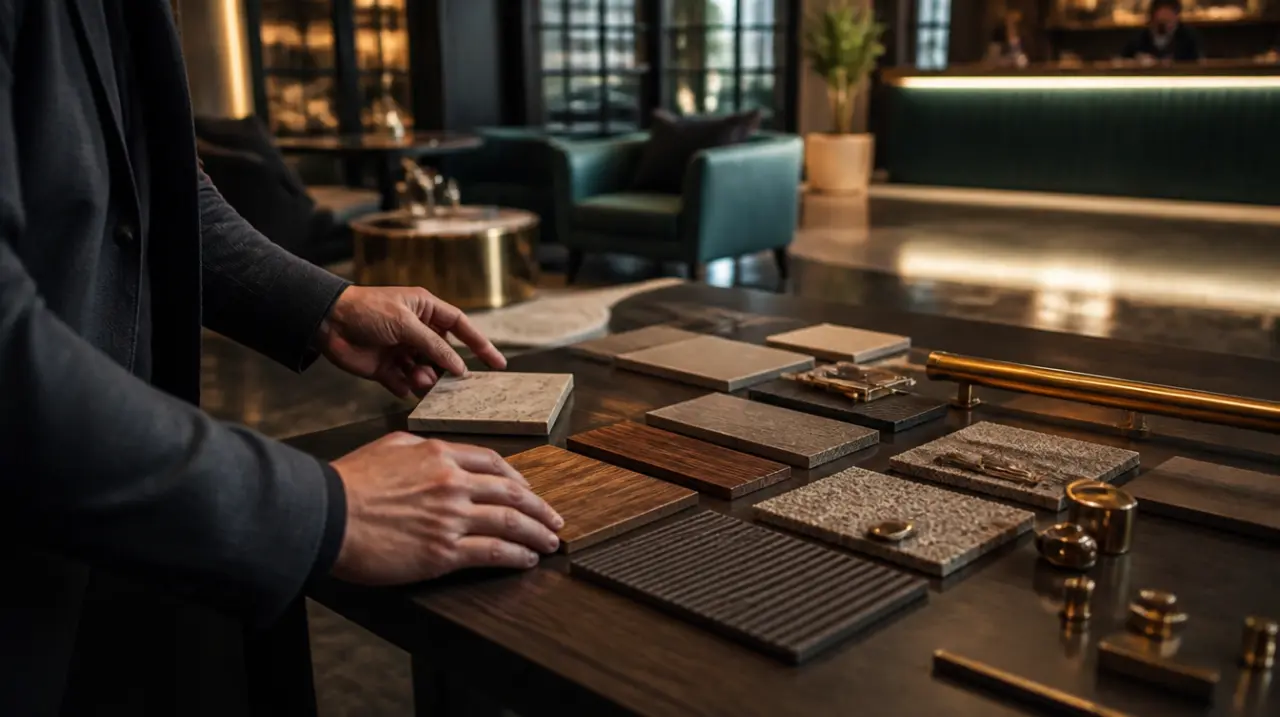
- Finishes: the finish schedule, including wood stain, laminate, metal finish, and edge detail, keyed to approved samples.
- Textiles: fabric or leather selection, the railroaded or up-the-bolt direction, pattern repeat, and the required flammability and durability standards.
- Performance and compliance: fire-rating, contract-grade durability, and any accessibility requirements.
- Cut sheet or shop drawing reference: the manufacturer’s drawing or an attached custom shop drawing.
The specification is the contractual description of the item. When product arrives, it is inspected against this document, and anything that deviates is a rejectable nonconformance. That is why the specification, not a verbal understanding or a showroom sample, is the reference of record.
How the spec book is organized
The spec book aggregates every item specification into one controlled document, usually organized the way the budget and the building are organized: by area and then by item. A typical structure runs guestrooms and suites, guestroom corridors, lobby and reception, lounge and lobby bar, food and beverage outlets, meeting and pre-function space, fitness and amenity, and back of house. Within each area the items are listed by tag with quantities rolled up to a property total.

This structure is deliberate. It mirrors the area-by-area logic of the FF&E budget, so that a specified item can be priced directly against the estimate, and it mirrors the delivery sequence, so that installation can be planned room type by room type. The JN+A and HVS Design Hotel Cost Estimating Guide lists FF&E at exactly this level of granularity, item by item within each area, with low, high, and average cost for each line. A specification written to that same granularity can be priced line for line, which is what makes an estimate defensible rather than a guess.
Specifications, budget, and cost control
A specification is where design intent meets money. The finish, grade, and textile chosen for a casegood or a lounge chair can move its cost by a wide margin, and those decisions accumulate across hundreds of rooms. Because FF&E is a distinct cost component in every development budget, tracked separately in the HVS U.S. Hotel Development Cost Survey and in the JN+A and HVS guide, the specification is the lever that keeps FF&E inside its approved number. Value engineering is executed through the specification: a substrate is changed, a textile is substituted to a lower grade, or a custom item is respecified to a standard product, and the spec book is revised to match. Aligning the specification with the FF&E budget at every revision is how the procurement team keeps scope and cost describing the same thing.

Custom versus standard specifications
Specifications fall on a spectrum from standard to fully custom, and the choice drives cost, lead time, and risk:
- Standard product: an item selected from a manufacturer’s catalog, specified by model number with a chosen finish and textile. Lowest cost and shortest lead time.
- Modified standard: a catalog item altered in size, finish, or material, priced and drawn as a variation.
- Custom: an item designed for the project and built from shop drawings. Highest control over the guest experience, longest lead time, and the greatest specification burden, because everything must be defined from scratch.
Branded projects add a further constraint. Franchise design standards and any active property improvement plan, the brand-mandated renovation scope, dictate minimum specification levels for casegoods, seating, and finishes. A specification that falls below the brand standard will not pass brand review, so the standard sets the floor before the designer’s intent is layered on top.
Submittals, samples, and approval
A specification is not finished when it is written. It is proven through a controlled approval workflow before production begins. For each specified item, the manufacturer returns submittals: product data, shop drawings for custom pieces, and physical samples of finishes and textiles. The designer and owner review each submittal against the specification and either approve it, approve it as noted, or reject it. Only an approved submittal authorizes the factory to build, and for custom casegoods a production sample, sometimes called a first-article or prototype, is inspected against the specification before the full run is released. This workflow is the single most effective defense against nonconformance, because it catches a wrong stain, a substituted substrate, or a reversed fabric direction on paper and on a sample rather than on a truckload of finished product.
Quantities, attic stock, and revision control
A specification is only complete when its quantities are complete. Each item carries a per-room quantity, a property total rolled up across room types and public areas, and an attic stock reserve, the extra carpet, fabric, and finish material held for future repairs so that a single damaged item does not force a full-priced reorder. Because the spec book is revised repeatedly as design develops and value engineering is applied, it must be version controlled. Every revision is dated and logged, superseded specifications are withdrawn, and the purchasing team works only from the current issue. A spec book without disciplined revision control produces the most expensive error in FF&E: buying the wrong version of an item in bulk.
From specification to purchase
The spec book is the input to the entire buying effort. During the FF&E procurement process, the purchasing team issues requests for quotation against each specification, evaluates bids for conformance rather than price alone, and releases purchase orders that reference the specification as the governing document. From there, each item’s lead time drives the delivery and installation calendar covered in the FF&E schedule and timeline. Submittals, samples, and shop drawings are approved against the specification, production samples are checked against it, and final receiving inspection closes the loop.
A strong FF&E specification therefore does three jobs at once. It defines the guest experience with enough precision to be built, it prices against the budget line for line, and it protects the owner at receiving by making conformance objective. Owners and procurement teams who invest in a complete, well-structured spec book buy fewer surprises, fewer nonconformances, and a project that arrives as designed.