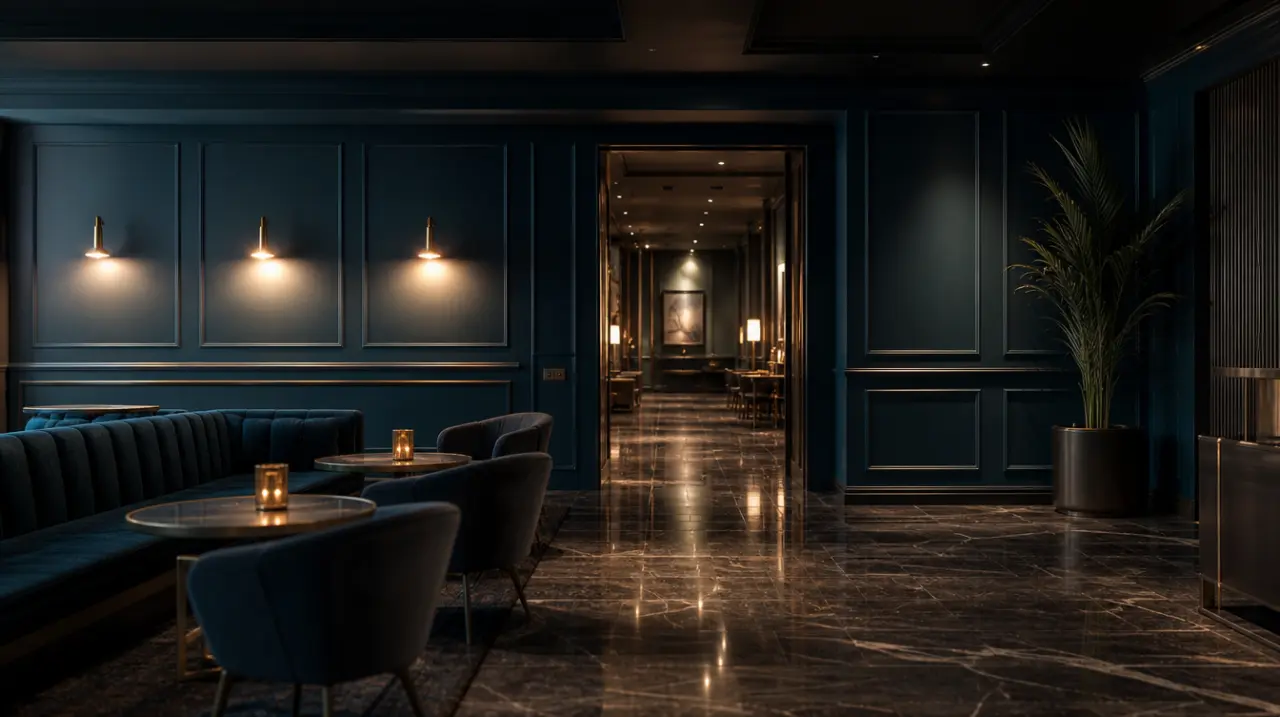
FF&E stands for furniture, fixtures, and equipment. It is a category of tangible, movable property that outfits a building without being part of its structure. In hospitality, the term is shorthand for everything an owner must buy to turn a finished shell into an operating hotel, from guestroom beds to lobby lighting to in-room safes. This page breaks down each letter, the variants of the acronym, and how the term is actually used in hotel contracts, budgets, and financial statements.
The three letters
Furniture covers the movable case and upholstered goods: guestroom beds, headboards, nightstands, desks and desk chairs, luggage racks, wardrobes, and the seating, tables, and casegoods that fill lobbies, corridors, and food and beverage outlets. In a guestroom package, casegoods and seating are usually the heaviest line by cost.
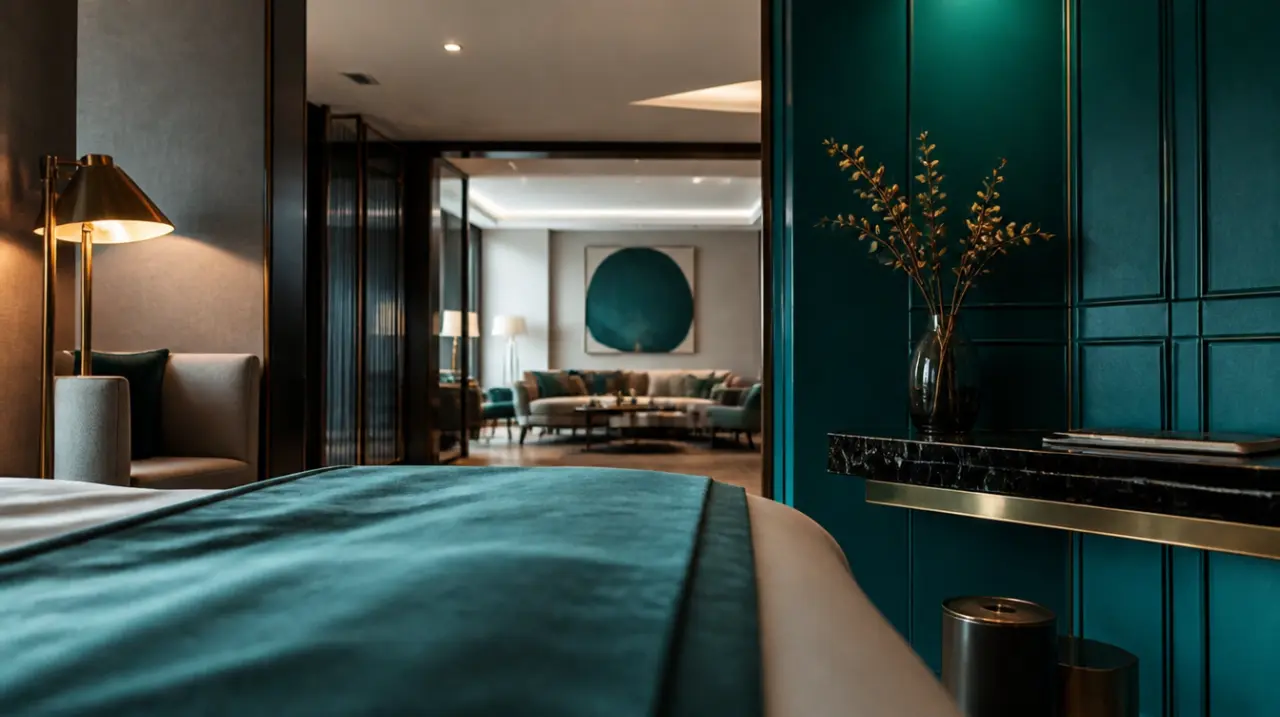
Fixtures are semi-permanent items that attach to the building but are not part of its structure and are usually installed under the FF&E scope rather than base construction. Decorative lighting, mirrors, framed artwork, window treatments, and some decorative millwork sit here. The word fixture can be confusing, because in general real estate a fixture is something so affixed it becomes part of the property. In the FF&E sense, a decorative light fitting is attached yet still treated as FF&E for budgeting and depreciation, because it is selected, purchased, and replaced on the design cycle rather than built in.
Equipment is the operating and technical gear a space needs to function: guestroom televisions, safes, minibars, and coffee makers, plus property-level back-of-house and kitchen equipment where the owner assigns it to the capital package. The E is the letter that causes the most confusion. The International Society of Hospitality Consultants notes that equipment definitions vary by owner and by brand, so the boundary between capital equipment inside FF&E and operating equipment inside a hotel’s day-to-day supplies is drawn differently on every project.
Why the boundaries matter
The point of the acronym is not vocabulary, it is money and responsibility. FF&E is capitalized as a fixed asset and depreciated over its useful life, whereas the consumables a hotel replenishes constantly are expensed as they are used. A single mislabeled line can shift a cost from the capital budget to the operating budget, change who pays for it under a management agreement, and change how it is taxed. Because of that, professional projects never rely on the acronym alone. They pair it with a written responsibilities matrix, sometimes called a differentiation document or diff doc, that names every item and records who specifies it, who purchases it, and who installs it. That document is what prevents the E from being argued over on site.

Variants of the acronym
Several forms of the term circulate, and a procurement team should read each one in context:

FFE and FF&E are the same thing written with or without the ampersand. Both are common in specifications and contracts.
FF&E and A or FFE and A adds artwork or accessories as a called-out fourth element on some projects, though most owners fold artwork into fixtures.
OS&E stands for operating supplies and equipment and is the sister category to FF&E. It captures consumable and shorter-life items such as linens, towels, glassware, amenities, and cleaning supplies that a hotel uses and replenishes. FF&E is generally the longer-lived property category; exact capitalization and expensing follow the owner’s accounting policy. The full comparison is covered in FF&E vs OS&E.
Because the categories interlock, a spec book will usually reference both, and the diff doc will assign every line to one bucket or the other so nothing is bought twice or missed entirely.
Where the term comes from
FF&E did not originate in hospitality. It is a long-standing accounting and commercial real estate term for the movable personal property attached to a business, as opposed to the real property of land and building. Any business with a fit-out, an office, a restaurant, a clinic, a store, carries FF&E on its books. Hospitality simply pushed the term to the center of its capital planning, because a hotel replaces its furniture, fixtures, and equipment far more often and far more visibly than most businesses do, and because brand standards force that replacement on a defined cycle. The accounting roots are why the term still carries a precise financial meaning rather than a loose design one: FF&E is the class of asset that is capitalized, depreciated, and, in lodging, reserved for.
FF&E in leases, sales, and management agreements
Outside the design studio, the term does most of its work inside contracts. In a hotel acquisition, the purchase agreement typically attaches an FF&E schedule, an itemized list of the furniture, fixtures, and equipment conveyed with the property, so that buyer and seller agree on exactly what movable assets are included in the sale and at what value. In a lease, the FF&E clause settles who owns and who maintains the movable goods, and what happens to them at the end of the term. In a hotel management or franchise agreement, FF&E is the property the owner funds and the operator uses, and the same agreement usually obliges the owner to fund an FF&E reserve for its replacement. In each of these documents the acronym is not decoration, it is the hinge that assigns ownership, value, and cost, which is why the responsibilities matrix and a clean asset schedule matter as much as the design intent.
How the term is used in practice
In a development pro forma, FF&E appears as a discrete line separate from the building hard costs and the soft costs, with its own budget, its own procurement schedule, and often its own dedicated purchasing agent. For the way that line behaves inside a construction budget, see FF&E meaning in construction.
In a hotel management or franchise agreement, FF&E is the property that the owner funds and the operator uses, and the same agreement usually obliges the owner to maintain an FF&E reserve to pay for its eventual replacement. On the balance sheet, FF&E is recorded as tangible fixed assets and depreciated, with hospitality furniture and equipment commonly carrying useful lives in the range of roughly five to ten years. Lodging owners book these assets under the industry’s standard framework, the Uniform System of Accounts for the Lodging Industry, so that the numbers are comparable across properties and clear to lenders.
Why teams still define it on first use
Given how established the acronym is, it is worth asking why careful specifications still spell out furniture, fixtures, and equipment on first use and still attach a diff doc. The answer is that the term is precise about the category but silent about the boundary. Two experienced teams can both use FF&E correctly and still disagree on whether a given television, coffee maker, or kitchen appliance is inside it, because the E is defined by owner and by brand rather than by the acronym. Spelling out the term removes ambiguity for a reader new to the project, and the responsibilities matrix removes ambiguity about who owns each line. In hospitality the word is treated as a starting point for a definition the project writes for itself, never as a definition that arrives complete.
The short answer
FF&E means furniture, fixtures, and equipment: the movable and other non-structural property that equips a hotel, kept distinct from the building it sits in and from the operating supplies the hotel consumes. Whether a particular item is capitalized depends on ownership, useful life, and the applicable accounting policy. For the full working definition and how the category runs across a project, start with what is FF&E, then read how the term is applied to the hotel asset specifically in FF&E in hospitality explained.