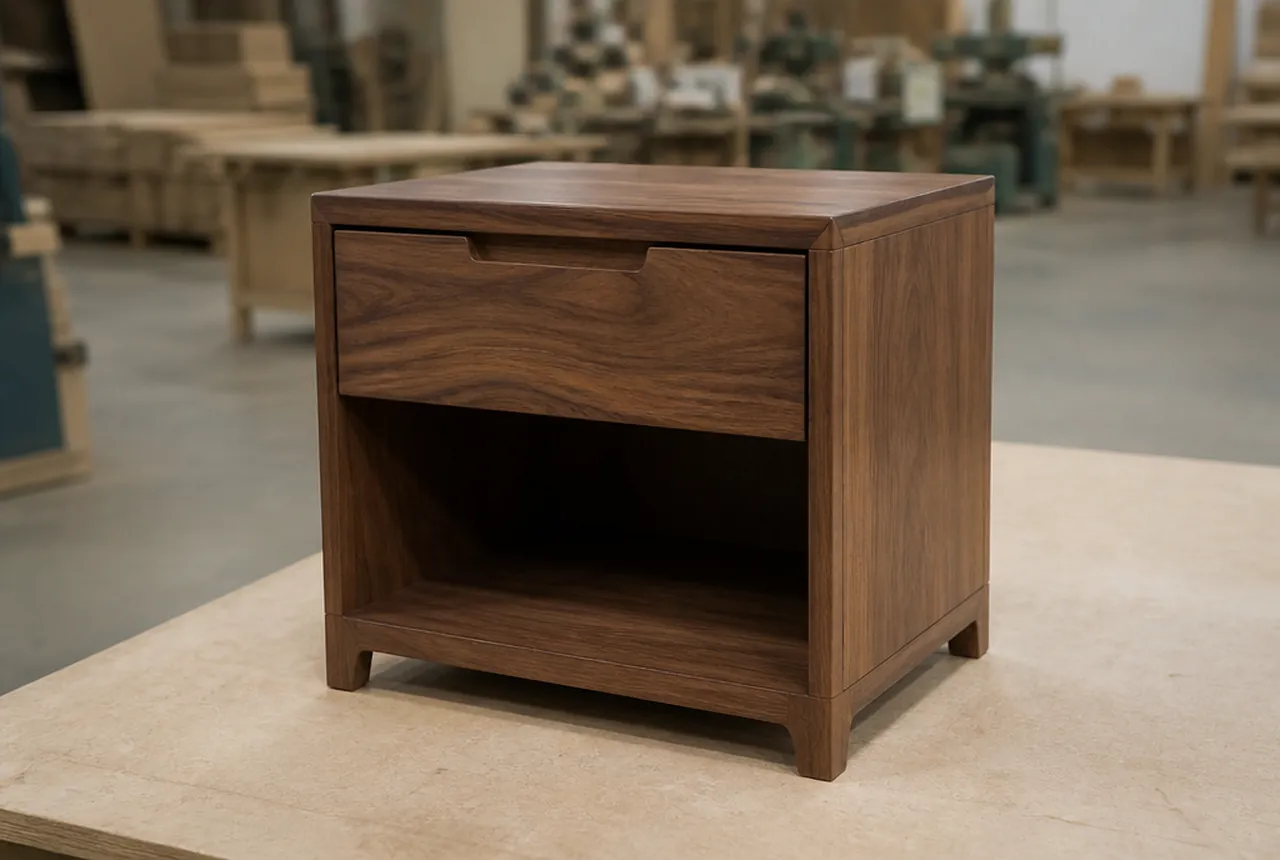
A nightstand proposal says it has a wood veneer finish and low-emission materials. The supplier sends a photograph of a panel label. Before accepting that as the furniture’s compliance evidence, ask which panel it identifies and how it relates to the finished nightstand being ordered.
The buyer’s task is to connect the actual furniture item to the right evidence. A label on raw board and a label on finished furniture have different contents. A certificate about forest sourcing answers another question again. Keeping those records separate makes it easier to find a missing answer before the order is released.
For furniture sourced for use in the United States, begin with EPA’s public labeling guidance. Have someone qualified review exemptions, unusual construction or the responsibilities you take on as an importer. A purchasing label check alone cannot settle those questions.
Start with the parts inside the item
EPA’s consumer guidance identifies hardwood plywood, medium-density fiberboard, including thin MDF, and particleboard as the three regulated composite-wood product types. The rules also address finished goods containing covered panels. A wood-looking face does not tell the buyer what is underneath it.
Ask the manufacturer for the material description by component: top, sides, drawer fronts, drawer bottoms and back, as applicable. Put the answer against the furniture item code. A broad description such as “wood construction” leaves the relevant question open.
For example, a supplier might describe a desk with a veneered MDF top and solid-wood legs. That is an illustrative construction, not a claim about a particular desk for sale. The MDF top calls for a different evidence discussion from the legs. Describing the visible veneer alone would miss it.
Do not decide that every engineered-wood product is covered, or that every item described as solid wood is exempt. Ask for the actual construction and, where the supplier claims an exemption, the specific basis. Record that as a question requiring resolution rather than filling the gap with your own interpretation.
Request finished-furniture evidence
EPA explains that covered finished goods produced in or imported into the United States after March 22, 2019 must carry a TSCA Title VI compliance label. Its stated finished-good label contents are the fabricator’s name, the production date in month/year format and a TSCA Title VI compliance statement.
The panel-label requirements are different: EPA lists the panel producer, lot number, recognized third-party certifier number and compliance statement. Do not require a panel certifier number on the furniture label merely because it appears on the board label. Conversely, a board-label photograph alone does not identify the fabricator or production date of the furniture being delivered.
Before production, ask the supplier to explain the labeling arrangement for the covered furniture and show the proposed label information. At receiving, check the actual labeling against that explanation. Where a product-specific labeling exception or alternative is claimed, have its basis reviewed; this article does not establish that every piece must be individually labeled in the same way.
The useful purchasing record can be short:
| Record | What to enter |
|---|---|
| Furniture identity | Item code, manufacturer, model and approved construction revision |
| Covered-material question | Which components contain the panel types under review |
| Finished-good evidence | Supplier explanation of labeling, fabricator identity, production month/year and compliance statement |
| Supporting panel information | Panel identity and evidence supplied, with its relationship to the furniture explained |
| Open issue | Missing information, claimed exception or conflicting construction description; named person to resolve it |
| Receiving result | Delivered item identity, label evidence checked and any discrepancy referred back to the supplier |
These are proposed procurement fields. They do not replace the legal records a manufacturer, distributor or importer must keep.
Keep other claims in their own columns
A formaldehyde-emissions compliance statement should not be used to approve every environmental or performance claim about a casegood. Wood sourcing, the project’s voluntary emissions certifications, finish durability and the furniture’s structural suitability each need their own evidence.
If the project requires a separate certification, list it beside the item and check the document against the required product and configuration. Do not write “environmental approval complete” after receiving one document with a different scope. The broader FF&E specification guide provides the place to carry those project requirements together; it does not make them interchangeable.
Suppose the supplier changes the top substrate after pricing. Reopen the material and evidence entries for that item, even if the stain and outside dimensions stay the same. Ask the supplier which previous documents still apply to the revised construction. Keep the approved revision attached to the purchasing record so receiving staff can compare the delivery with the version actually ordered.
Resolve gaps before calling the item approved
An unreadable label photograph is an unanswered question. So is a compliance statement attached to a different furniture model. Ask for a legible record and the connection to the item being bought. Give the supplier the item code and the exact missing field rather than asking for an undefined “green certificate.”
If the buyer will import the furniture directly, settle who is handling the applicable import obligations before ordering. The consumer label guidance used here does not cover that job in full. Likewise, do not infer that a labeling check establishes health outcomes, all chemical-emissions performance or suitability for the hotel occupancy. Those are broader claims than this record supports.
The order can move forward when the person responsible for this review has a resolved item-level answer, the supplier’s evidence matches the approved construction and the remaining project requirements have their own recorded review outcomes. Save that record with the specification and carry the labeling check into receiving. It gives the next person a concrete reference instead of a folder of documents whose relationship to the furniture is unclear.