
Check the supplier’s drawings, product data and physical samples against the approved order before recording an approval. A folder marked approved should tell the factory whether you accepted a finish, an entire chair or only one drawing. For each item, identify the evidence required, send it to reviewers with defined authority, and record their decision against the relevant revision. Then issue the production release required by the purchase order.
FF&E means furniture, fixtures and equipment. This guide covers the review between supplier selection and production release. The procurement overview explains the wider sequence, while the specification guide describes the document each submittal must be checked against.

Define the review scope before the first submission
Start with the current specification, awarded configuration and supplier acknowledgement. If an alternate was accepted during bid levelling, update the governing record before asking the vendor to prove conformity. Otherwise a reviewer may reject the very alternate that purchasing intended to order.
Create one register row for each required submission, rather than one undifferentiated “samples” box per vendor. A chair may have a product sheet, a frame finish, a fabric cutting and an assembled sample. Those records can reach different reviewers and finish at different times.
Use the contract, specification and manufacturer requirements to decide which evidence is required. Standard catalog items and custom work need different packages. AWI 100 provides a useful woodwork example: its scope includes shop drawings, material and product data, and samples. Its architectural-woodwork scope is not a universal rule for every loose FF&E item.
Name who can approve design appearance, operating requirements, technical coordination, commercial changes and production release. Record delegated authority and the route for conflicting comments. A procurement coordinator can administer the register without having authority to accept every decision in it.
Ask what each piece of evidence actually proves
Separate visual review from performance documentation. Use the order’s requirements to complete this suggested record.
| Evidence | Question it can answer | Additional evidence to check |
|---|---|---|
| Product sheet | Which model and published configuration are offered? | Options selected, current revision and any deviations |
| Shop drawing | What dimensions, connections and details are proposed? | Verified field interfaces and the project’s coordination review |
| Finish sample | Which colour, sheen and visible finish are proposed? | Sample identifier, substrate and agreed comparison conditions |
| Fabric cutting or strike-off | Which material, colourway, direction or pattern is proposed? | Supplier reference, relevant lot status and required test documentation |
| Prototype or first article | How do the assembled parts fit and function? | The exact drawing/material revisions represented and untested differences |

A fabric’s appearance does not establish its fire or durability performance. ACT’s guidelines distinguish tests and applications by fabric construction, intended use and environment. Request the evidence required for the specified covering and application; a rating from another material is not a substitute.
Likewise, ask whether a fabric sample represents available stock, a proposed colour or a committed production lot. Have the supplier state whether the cutting represents the eventual lot and whether the sample commits them to inventory. Record those answers with the submission.
Log identity, deviations and dates at intake
Require the transmittal to identify the project, item, purchase-order reference, specification revision, submission number, submission revision and the evidence enclosed. Log receipt before routing. If a package cannot be matched to an item, return it for identification instead of creating an approval that will be difficult to trace.
Ask the supplier to list deviations explicitly. A different substrate, finish process, dimension or hardware selection should be visible beside the requirement it changes. Decide whether it is a clarification, a substitution or a proposed order change under the project’s own process.
Set the review due date from the agreed production programme and the review period, including return of physical samples and any resubmission. Obtain the supplier’s actual dependencies: which approvals release which production activities, and whether other requirements such as payment or supplied material remain open. Avoid a universal assumption that every item needs two review rounds or that every review takes a fixed number of weeks.
Review coordinated evidence against one current issue
Give reviewers the same current specification, submission and comment record. Check drawing dimensions and interfaces with the people responsible for field verification, building services and installation. Design approval and field coordination should have identifiable owners; one should not disappear because the other has signed.
View the proposed materials together using the agreed review conditions. The materials-board guide can help organise the palette. If review is remote, document which decisions were made from images and which still require physical evidence. Keep image approval limits explicit.
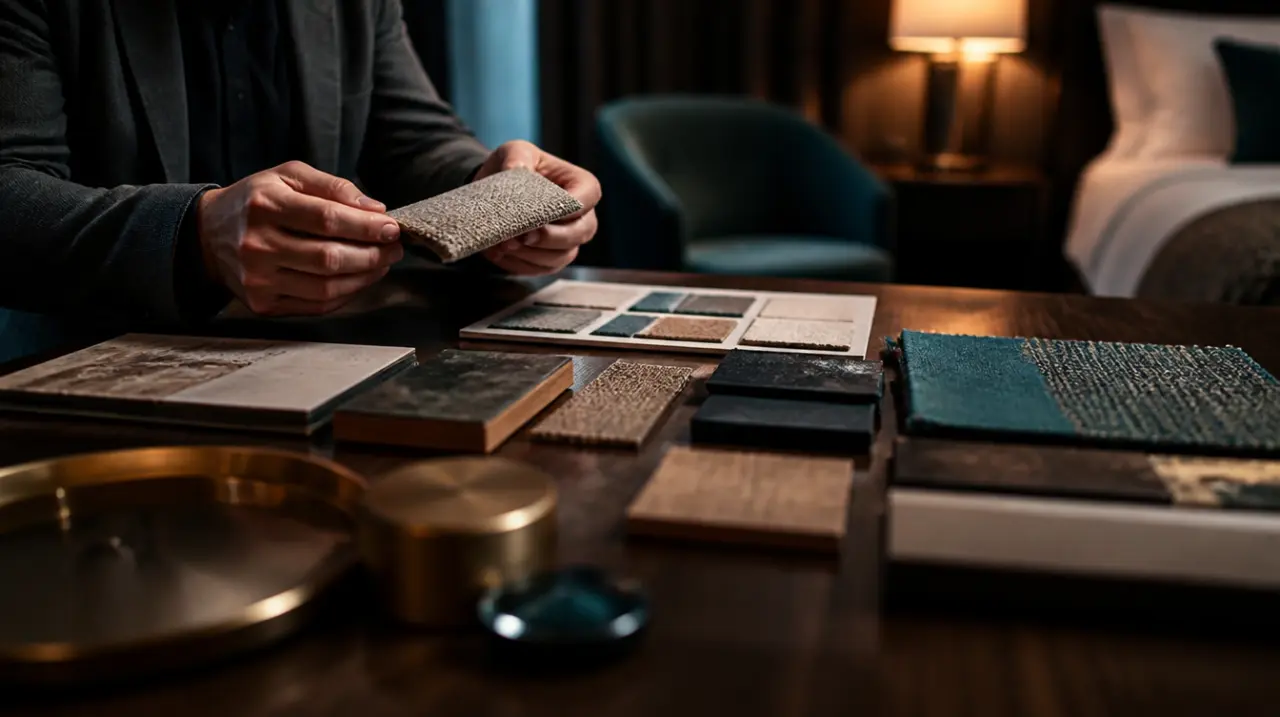
Number comments and connect each one to the affected item, drawing or sample. “Revise depth to match dimension on detail 3, then confirm field clearance” gives the next review a checkable task. “Please coordinate” leaves both the supplier and coordinator to decide what closure means.
Define the disposition and its limits
Use the project’s agreed status vocabulary. Do not infer production permission from the stamp’s label alone.
| Returned status | Record needed before the next action |
|---|---|
| Approved | Scope, revision, approver and any separate release conditions |
| Approved as noted | Exact notes, responsibility for incorporating them, and whether further evidence or resubmission is required |
| Revise and resubmit | Numbered changes, due date and the activities that remain held |
| Rejected | Identified nonconformity and the required replacement or escalation |
| For information or incomplete | A clear statement that this does not close a required approval |
Where a comment changes cost, quantity, delivery or the purchased configuration, send it through the authorised commercial-change process. A design annotation should not silently amend the purchase order.

For an illustrative lounge-chair package, the finish chip may be approved while the drawing is returned to resolve a seat-dimension change. Keep both outcomes in the register. If the order requires drawing approval before production, the approved finish does not close that hold. If the revised dimension affects the sample already reviewed, route the affected approval back to its owner.
Close comments and issue a separate release record
For a resubmission, keep the earlier issue and ask for a response to every numbered comment. Review the changed areas and their dependencies. Mark an old file superseded so nobody builds from the wrong attachment, but retain it in the history.
Before release, reconcile the required approvals for the item. Identify missing documents, unaccepted deviations, required field confirmations and commercial changes. Where a partial release is permitted, state precisely which items, quantities or activities it covers and which remain held.
Issue the authorised release in the form the order requires. Reference the accepted drawings, materials, sample identifiers, revisions and closed comments. Obtain the supplier’s acknowledgement and updated production dates. Keep the actual release separate from sample receipt, review completion and payment dates; their sequence depends on the agreed terms.
Retain the reference that receiving will need
Agree custody of approved samples and reference materials, including any copy kept by the supplier. Label them with item and revision, protect them appropriately, and record where they can be found. The register should point to a physical reference rather than say only “designer has it.”

Send receiving the current item/configuration, accepted revisions, available control samples and observable inspection checks. For customer-supplied fabric, include the buyer’s material approvals and the manufacturer’s acceptance of that covering as relevant to the order. Do not let the responsibility fall between the textile supplier and chair maker.
The process is complete when a person outside the review meeting can identify what was approved, who authorised it, what was released and which evidence should be used to inspect the delivery. That record is more useful than a green status cell with no traceable decision behind it.