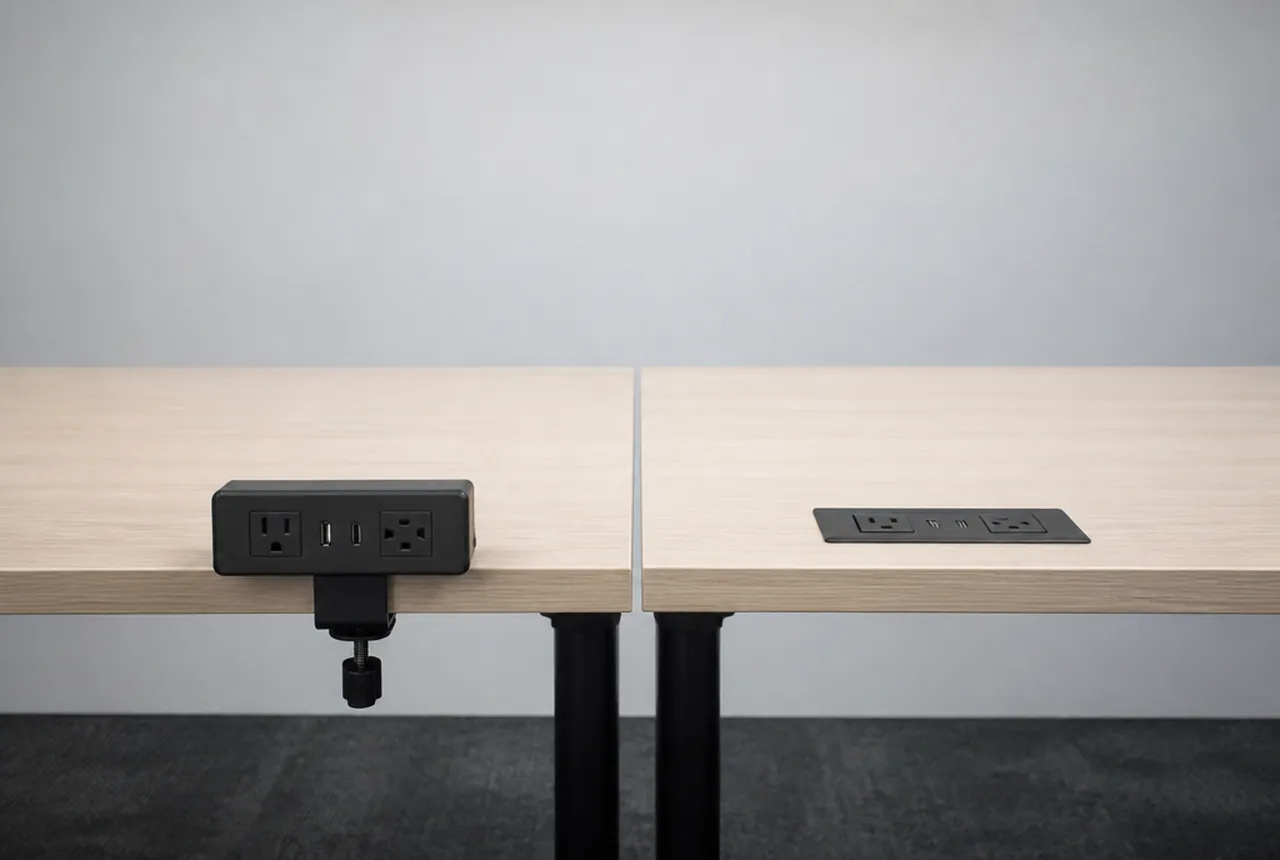
A desk top can be ready for fabrication while the power module is still described as “outlets and USB.” That leaves the factory choosing a hole before the project has chosen what goes into it. The unresolved choices include the size of the module, what its USB connections do and how it receives power.
Settle those choices before approving the cutout. The furniture drawing, the module’s current manufacturer documents and the project’s electrical review need to describe the same configuration. An outside housing dimension copied from a brochure is not a substitute for the specified opening in the top.
Give the module its own identity
Record the manufacturer, exact model or ordering reference, configuration and document revision beside the furniture item code. Include the outlets and technology connections the project actually needs. “Two USB ports” leaves open whether the connections supply charging power, transfer data or serve another function.
Byrne’s Ellora V0225 cut sheet, for example, distinguishes powered technologies from non-powered connections and says its powered technologies do not transfer data. It also identifies DisplayPort and Mini DisplayPort as factory-install options. Those are model-specific details to resolve with the supplier, not rules for every furniture module.
Ask the operator to describe the intended use plainly: charge a device, connect a display, or provide an electrical receptacle. Then have the supplier identify the offered configuration that meets that use. Confirm current availability with the supplier; a public family sheet does not establish that every combination can be ordered for this project.
Attach the accepted configuration to the furniture specification. The FF&E spec book should make it possible for the furniture factory and the module supplier to find the same reference without interpreting a presentation image.
Use the cutout dimensions for that configuration
The Ellora sheet shows why a family name is insufficient. Its two-window configuration calls for a 5-inch by 5-inch cutout. The eight-window configuration calls for 14 inches by 5 inches. They share a product family, but not an opening length.
That is a 9-inch difference in the stated cutout length. It does not mean every larger module needs 9 more inches, or that a buyer can enlarge an existing top without further review. It is a direct comparison of those two entries on that manufacturer’s sheet.
On the furniture drawing, distinguish the opening from the outside housing, flange and space occupied below the top. Ask the manufacturer which current drawing governs each dimension and whether its mounting method is compatible with the proposed top material and thickness. The furniture fabricator needs that information before it can approve the detail around the opening.
Do not scale a product photograph or turn an approximate overall dimension into a shop instruction. If the sheet, supplier drawing and ordering reference disagree, send that conflict back for a resolved manufacturer detail. Leave fabrication of the affected opening on hold until the responsible reviewers accept it.
Draw the space below the top
A module can fit the top opening and still conflict with a drawer, apron or support immediately underneath it. Ask for a section showing the installed module, its mounting hardware, the adjacent furniture parts and the cable path. Check the drawer through its normal travel and the module through its normal operation.
Byrne’s Ellora installation sheet specifies a normally dry worksurface and sufficient cable allowance for the lid to open and close. Apply the actual instructions for the selected version. Marketing language about spills should not be used to approve installation in a wet location or to change the manufacturer’s stated conditions.
The project team should also agree how the module can be serviced. Which furniture part, if any, has to be removed? Can the authorized technician reach the connection and mounting points? Who supplies the replacement part if it is needed? Have the supplier show the approved arrangement rather than asking the site crew to improvise one after installation.
This is coordination for a qualified installer and the manufacturer. It is not a guide to wiring, cutting an installed desk or modifying a listed electrical product.
Resolve the electrical connection separately
The cutout drawing answers where the module sits. It does not establish that the proposed connection is suitable for the project.
Have the project’s qualified electrical team review the exact infeed, supply location, applicable product documentation and local requirements. Give them the selected configuration and furniture drawing, including the cable route. Do not transfer a listing claim from one version to a different infeed or treat a plug connection and a hardwired connection as interchangeable.
Put the responsibility for ordering and installing the module in writing. If the furniture supplier provides only the prepared top, the order needs to say who provides the module and when its final dimensions will reach the factory. If the supplier provides the assembly, ask who has confirmed the module configuration and the building connection. Either arrangement can be reviewed; an unassigned connection cannot.
Release one coordinated record
Use a short approval record tied to the furniture item:
| Entry | Evidence to retain |
|---|---|
| Intended use | Operator’s requested charging, power or data functions |
| Exact module | Accepted ordering reference, configuration and current manufacturer documents |
| Top preparation | Approved cutout, material/thickness compatibility and mounting detail |
| Underside fit | Section with drawers, aprons, supports and cable path |
| Electrical review | Named qualified reviewer, accepted connection and any conditions still open |
| Supply and service | Who supplies and installs each part; approved access for later service |
These are suggested project fields, not a manufacturer’s installation checklist. The manufacturer instructions and the project’s approved electrical requirements remain the governing inputs.
If the module changes, reopen the affected entries before approving a revised furniture drawing. An apparently similar replacement may change the opening, connections or space below the top. The useful release is one accepted assembly record that the factory can build from and the installer can compare with the delivered furniture.