A supplier describes a lounge-chair cushion as high-density and firm. Ask for the two properties separately. Density describes mass per volume; firmness describes resistance to indentation under a stated test. A foam can be dense and soft, or less dense and firm.
That distinction matters when comparing seating proposals. Choosing a firmer feel does not necessarily choose a different density, and matching the first firmness number does not necessarily match support deeper into the cushion. Request the core information behind the finished seat before treating two upholstery options as equivalent.
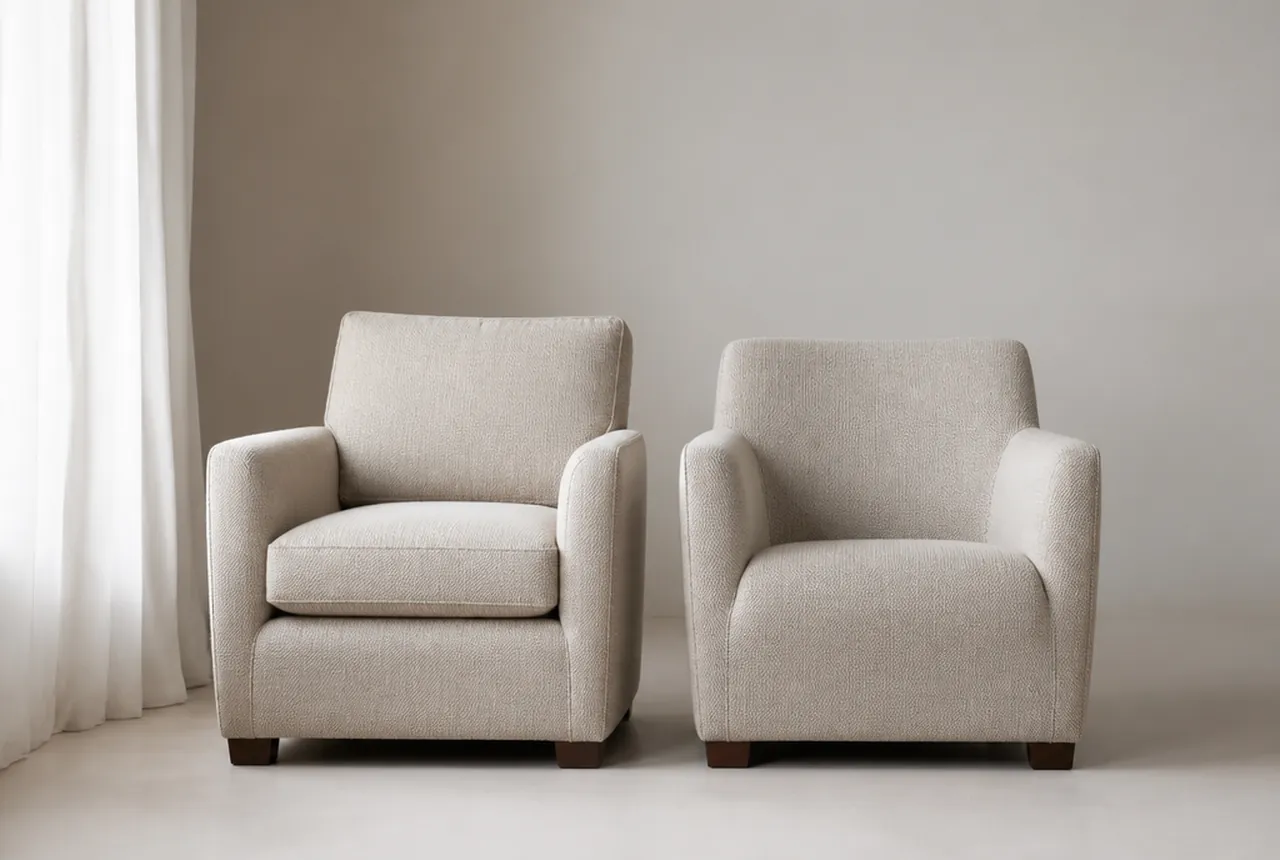
Read density in its own units
The Polyurethane Foam Association reports density in pounds per cubic foot or kilograms per cubic meter. For specification, it advises using polymer density, which excludes fillers and reinforcements. Ask which density basis the supplier reports before comparing numbers from different sheets.
A density value is not a pound-force firmness result or a sitter-weight capacity. PFA associates higher polymer density with better retention of original properties, but that does not give a universal service life or a single correct density for every hotel seat.
Have the furniture maker identify the actual foam grade and where it goes. Seat, back and arm padding serve different purposes. An overall description of “high-density foam” leaves open which part of the chair it describes.
Compare firmness under equivalent test conditions
Indentation Force Deflection, or IFD, measures the force needed to indent the foam to a stated percentage of its height. The initial firmness value commonly discussed here is the 25-percent result. Keep the force unit and indentation percentage beside the number.
PFA’s laboratory-testing overview, revised in 2022, describes a 50-square-inch platen and force measured after a one-minute dwell. It also notes that IFD depends on thickness. A bare “30 IFD” entry therefore leaves information missing.
Request the test method and revision, specimen dimensions, conditioning, indentation percentage, dwell and result units from the supplier’s actual report. Compare equivalent procedures and samples.
Review the finished cushion too. PFA’s furniture discussion illustrates foam layers combined with fiber. The cover, wrapping, core thickness and supporting construction can change how the seat feels. A core result cannot describe all of those together.
Look beyond the first firmness number
Support factor compares the 65-percent IFD with the 25-percent IFD. Divide the former by the latter using results from the same foam and compatible test conditions.
Consider these hypothetical laboratory results. They are examples for reading a supplier comparison, not recommended acceptance values:
| Proposed core | 25% IFD | 65% IFD | Support factor |
|---|---|---|---|
| A | 30 pounds of force | 60 pounds of force | 60 ÷ 30 = 2.0 |
| B | 30 pounds of force | 75 pounds of force | 75 ÷ 30 = 2.5 |
Both have the same 25-percent IFD. Core B requires more force at the deeper indentation and has the higher support factor. That difference is useful to discuss with the maker, especially when a proposal seeks a soft initial feel with support deeper into the cushion. It does not establish that B is the more comfortable finished chair for every guest.
Keep density as a separate entry in this comparison. Neither row supplies it. You cannot calculate density from these firmness results or assume matching IFD means matching foam construction.
Ask what the core retains after fatigue
Initial results describe the starting material. PFA explains that flex-fatigue tests compare firmness and height before and after specified cycling. If a supplier offers durability evidence, ask for the procedure, cycling conditions, recovery interval and retained-property results for the proposed foam.
Do not convert a cycle count into years in a hotel or treat a warranty period as the same measurement. A useful comparison shows what changed under the stated test and how that relates to the maker’s proposed application.
The furniture standards guide covers the broader evidence for the completed piece. Covering performance and any applicable fire requirements still need their own review; a density or support-factor number does not answer them.
Before choosing the upholstery package, compare identified foam grades, density basis, equivalent IFD results and the actual cushion layers. Then review the proposed finished seat with the operator. Carry the accepted construction into the furniture specification, so a later change in core or wrapping gets considered as a change to the seat you chose, even when the fabric stays the same.